pvc veneer laminating adhesive
1. Suitable for veneer lamination of PP, PVC and PET, widely applied for wooden door lamination.
2. Good adhesion for bonding PVC to MDF, gypsum board or plywood.
3. Capable of bonding two non-permeable substrates (except metal).
4.Service: Custom OEM & ODM solutions available.
5.Model: AQUENCE PL 3294/918.
PVC veneer laminating adhesive for medium-density fiberboard and gypsum board | Zero-formaldehyde adhesive liquid
Sanyou pvc veneer laminating adhesive (AQUENCE PL 3294/918 series) is a professional-grade water-based emulsion adhesive designed specifically for furniture and wooden door manufacturing. This solvent-free and formaldehyde-free glue provides excellent adhesion to PVC film and porous substrates such as medium density fibreboard (MDF), gypsum board and plywood. Uniform coating effect and high adherence may be obtained with a viscosity of 52,000 cps and a solids content of around 53%. Furthermore it may be used to bind two non-porous surfaces (except metals) which is excellent for today's flat veneer manufacturing lines.
Main product features
This glue is developed for PVC flat lamination applications. It is white emulsion in appearance and has a high solids content for uniform application throughout the press process and great wet tack performance.
The solvent-free, formaldehyde-free solution is particularly significant for producers aiming for eco-friendly furniture certification or serving markets with strict indoor air quality standards. It guarantees a strong adhesion, preserving the environment and work place.
This adhesive may be used with PP, PVC and PET finishes, enabling your manufacturing line to flexibly apply several kinds of decorative films.For PET applications, due to PET's low surface energy, small-batch machine trials are strongly recommended before full-scale production.
Technical specifications of PVC veneer laminating adhesive
| scope | value |
|---|---|
| Model | AQUENCE PL 3294/918 |
| appearance | White emulsion |
| Viscosity (Brookfield) | 52,000 mPa·s (cps) |
| Solid content | Approximately 53% |
| Package | 20 kg/barrel |
| Hot pressing temperature | 80–100°C |
| Hot pressing pressure | 2–4 kgf/cm² |
| hot press residence time | 5-8 minutes |
| Cold press residence time | 4 hours |
| System type | Two-component (base material + curing agent) |
| Summer hardener ratio | 3 parts hardener; cold press for 5-10 minutes |
| Winter hardener ratio | 5 parts hardener; cold press for 30 minutes |
Application scenarios
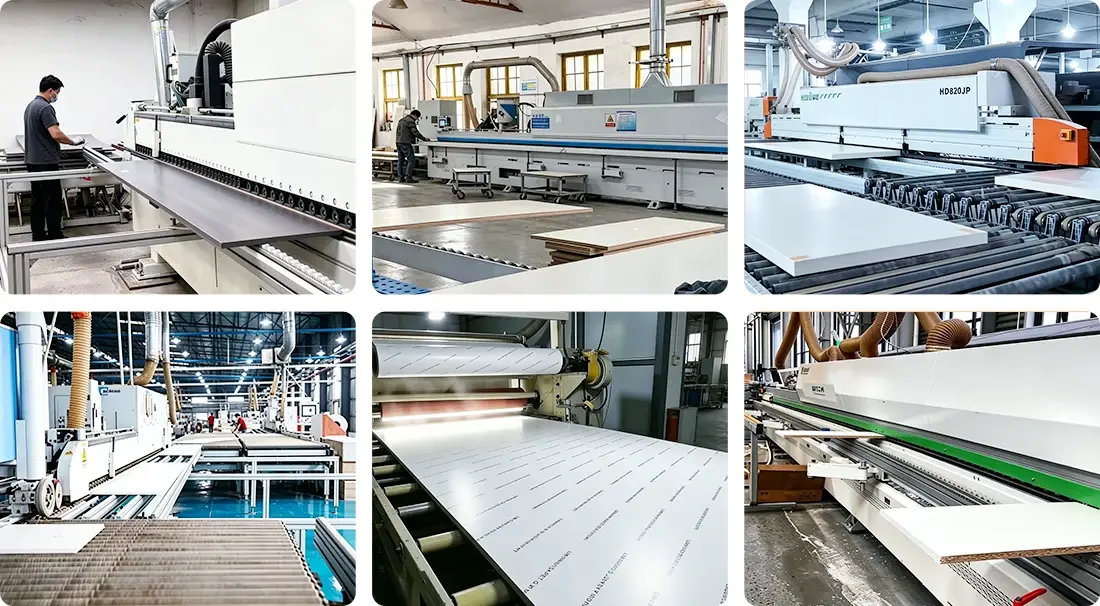
This type of pvc veneer laminating adhesive is widely used in the production of wooden door panels. On an industrial scale, it is necessary to flat-press the PVC decorative film onto MDF or gypsum board substrates.
Production of wooden doors: The PVC film is glued to the MDF core using a strong and lasting adhesive. Controlled pressing temperature range (80-100°C) eliminates plasticiser migration and film whitening, two of the most typical problems in door veneer finishes.
Gypsum board veneer: Large variances exist between batches of gypsum substrate in porosity, pH value and absorptive capacity for glue. For consistent results from batch to batch, it is suggested to pre-seal the gypsum board surface before applying the glue.
Plywood veneer: Adhesives may be bonded strongly to the surface of plywood. This allows the manufacture of laminates for cabinet doors, closets and parts of the interior of furniture.
Bonding to non-permeable substrates: This formulation allows the bonding of two non-permeable substrates (except metals) and so extends the range of possible applications to specialised lamination applications beyond the typical wood-based panels.
Application and Process Guide
Proper process control is essential for consistent lamination quality. Strictly observe the seasonal hardener mixing ratio, do not use more hardener than advised, as this can impair open time, bond strength and surface quality.
The temperature of hot pressing should be maintained in the region of 80–100°C. Too much heat might lead to migration of the plasticiser in the PVC film which results in surface whitening and loss of adhesion.
For gypsum board substrates with significant batch-to-batch variations, substrate sealing pretreatment helps stabilize adhesive absorption and improve bonding consistency. This is a practical step frequently used by experienced operators on high-volume production lines.
For PET film lamination, small-batch machine sample testing must be conducted first. PET film has a lower surface energy than PVC, therefore large-scale production is not recommended without prior testing.
Why choose Sany's laminating adhesive?
With over 20 years of experience in adhesive formulation and industrial applications, Sanyou provides comprehensive support to its customers, from product selection to production optimization. This is not a general-purpose adhesive, but rather designed specifically for PVC flatbed lamination, featuring differentiated seasonal curing agent ratios, an environmentally friendly formulation, and proven compatibility with medium-density fiberboard (MDF) and gypsum board substrates.
OEM and ODM are available. For whatever need on viscosity, open time, hardener ratio or packaging, Sany's R&D team can customise the formulas to match your manufacturing process. Upon request we may provide samples and technical papers like TDS and SDS.
Shipping time for in-stock pvc veneer laminating adhesive products is 2-5 days. Standard orders ship within 10-15 business days, and OEM/private label orders ship within 12-18 business days.
Frequently Asked Questions
Q: What substrates is this adhesive suitable for?
A: It can bond PVC film to medium-density fiberboard, drywall, and plywood. It also supports bonding two waterproof substrates, but not metal surfaces.
Q: Why use a two-component system? Will the proportion of the hardener change with the seasons?
A: Yes. In summer, add 3 parts hardener and cold press for 5-10 minutes. In winter, add 5 parts hardener and cold press for 30 minutes. This can compensate for the difference in curing speed caused by temperature differences.
Q: What causes PVC film to turn white during the hot pressing process?
A: Whitening of the film is usually caused by excessively high pressing temperature, which leads to the migration of plasticizers in the PVC film. The hot pressing temperature should be maintained between 80-100℃ to avoid overheating.
Q: How should the gypsum board substrate be treated to ensure consistent lamination results?
A: The porosity and pH value vary between different batches of gypsum board. Before applying adhesive, the surface of the board should be pre-sealed to stabilize the water absorption rate and improve the uniformity of adhesion.
Q: Can this product be used directly for PET film lamination?
A: We do not recommend proceeding with large-scale production directly. PET has a lower surface energy than PVC. It is essential to conduct small-batch trial production first and confirm the results before proceeding with mass production.
Q: Is this product environmentally friendly in furniture manufacturing?
A: Yes. This formula contains no solvents or formaldehyde, making it suitable for environmentally conscious furniture production and markets with stringent indoor air quality standards.
Contact Us
Do you have projects that require or need samples of pvc veneer laminating adhesive ? Please email our team at sales@sayiyousolutions.com – we will respond quickly and provide product recommendations and technical support.